

 Image 1 of 4
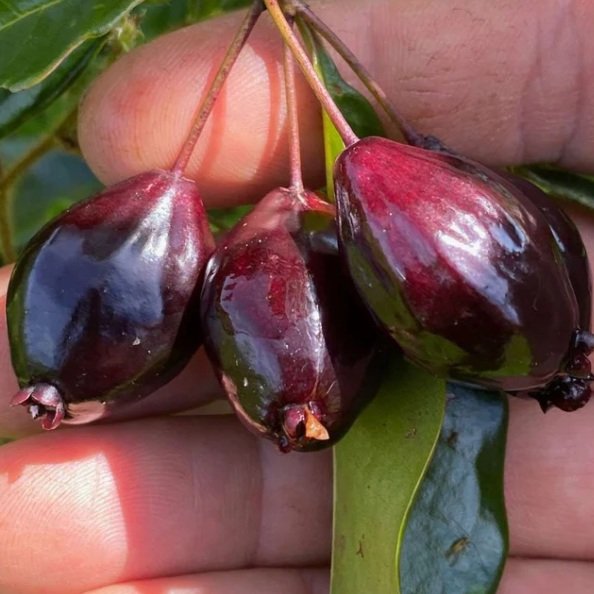 Image 2 of 4
 Image 3 of 4
 Image 4 of 4
Eugenia zuccarinii, commonly known as Guapi-Nhem Acu, is a rare and versatile small tree native to the forests of Rio de Janeiro, Brazil. Despite its tropical origins, it demonstrates surprising frost tolerance, surviving temperatures as low as 26°F, making it suitable for subtropical and cooler gardens. The tree is highly ornamental, producing large, fragrant flowers that attract pollinators such as honey bees, supporting local biodiversity.
Eugenia zuccarinii also produces flavorful fruits with abundant pulp, offering a taste reminiscent of dried plums and cherries. The fruits are excellent for fresh consumption or for use in juices, ice creams, and jellies. With its combination of aesthetic appeal, edible produce, and adaptability, this species is well-suited for home gardens, tropical collections, and even cooler climate cultivation. Typically, it begins flowering and fruiting within 3–4 years, providing both beauty and bounty relatively quickly.
Seeds are shipped in packs of 1, shipped in humid vermiculite.
Eugenia zuccarinii, commonly known as Guapi-Nhem Acu, is a rare and versatile small tree native to the forests of Rio de Janeiro, Brazil. Despite its tropical origins, it demonstrates surprising frost tolerance, surviving temperatures as low as 26°F, making it suitable for subtropical and cooler gardens. The tree is highly ornamental, producing large, fragrant flowers that attract pollinators such as honey bees, supporting local biodiversity.
Eugenia zuccarinii also produces flavorful fruits with abundant pulp, offering a taste reminiscent of dried plums and cherries. The fruits are excellent for fresh consumption or for use in juices, ice creams, and jellies. With its combination of aesthetic appeal, edible produce, and adaptability, this species is well-suited for home gardens, tropical collections, and even cooler climate cultivation. Typically, it begins flowering and fruiting within 3–4 years, providing both beauty and bounty relatively quickly.
Seeds are shipped in packs of 1, shipped in humid vermiculite.